Replicate sunlight with plasma or metal halide lamps alongside controlled temperature and humidity — for UV aging, material durability, and combined-exposure testing from lab-scale to drive-in-scale programs.
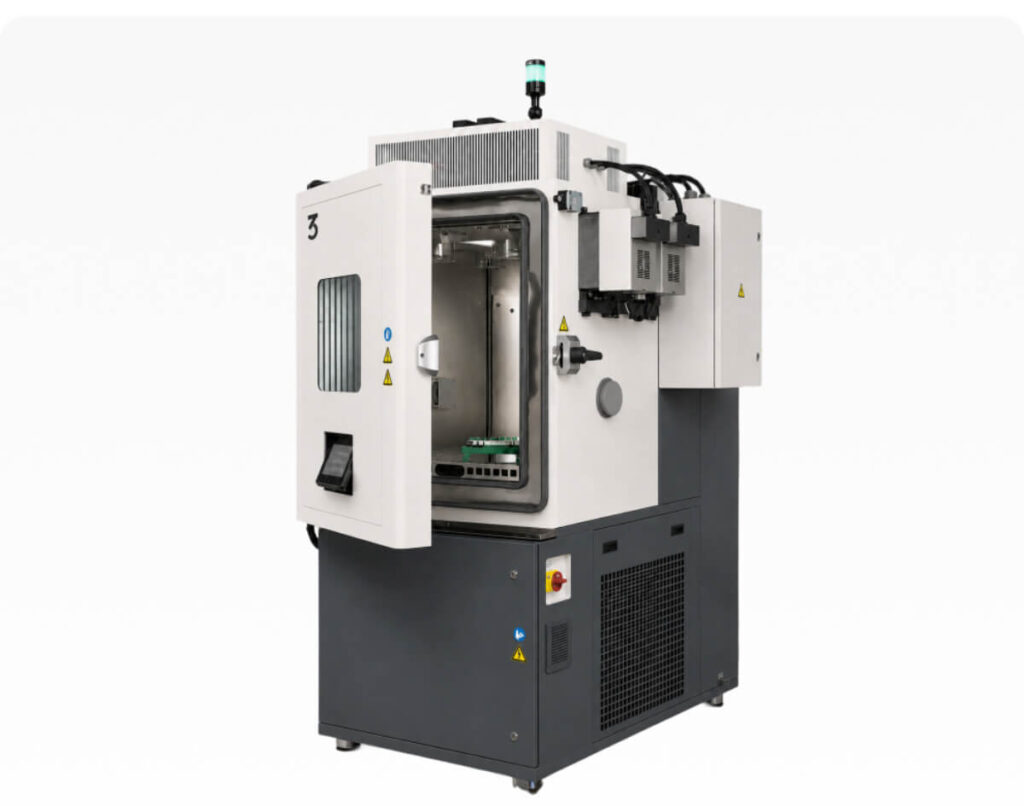
Solar simulation chambers replicate the effects of sunlight together with controlled temperature and humidity, so teams can assess material durability, product aging, and performance under realistic solar exposure. They reveal how UV, visible light, heat, and moisture interact over time — the combined stress no single-factor test can reproduce.
T3 solar simulation chambers are available in a wide range of sizes and are configured with plasma or metal halide lamp technologies to meet demanding irradiation requirements. Precise climate control, filter-glass integration, and durable chamber construction support repeatable, standards-aware testing across both lab-scale and large-format programs.
These systems serve automotive, aerospace, solar and energy, material, agriculture, consumer, and battery-related programs where sunlight exposure, UV resistance, and environmental aging must be measured with confidence. For climate-only PV module protocols, see our solar panel test chambers.
Realistic solar aging takes more than a bright lamp — spectrum, uniformity, climate, and endurance all have to hold across the full test duration.
From benchtop material coupons to complete vehicles under solar loading — one design language across the range.
Full-spectrum lamp packages configured to your irradiance requirement — plasma for stable long-duration output, metal halide for high irradiance over large areas. Filter-glass integration shapes the spectrum for realistic, standards-aware exposure.
Uniform temperature and humidity control runs simultaneously with irradiation — capturing the combined light-heat-moisture interactions that drive real-world aging, not just UV dose alone.
Robust chamber construction and durable lamp systems are designed for extended weathering programs — where tests are measured in weeks and months, not hours.
Send us the standard, target irradiance, and specimen size. Our engineers respond with a matched lamp and chamber configuration within 24 hours.
Every chamber is configured around your specimens, irradiance target, and test durations.
| Specification | Configuration |
|---|---|
| Lead Time | < 24 weeks |
| Standard Models | 20 CFT to large custom systems |
| Lamp Technology | Plasma or metal halide lamp packages |
| Optical Conditioning | Filter-glass integration for realistic light filtration |
| Customization | Fully customizable — size, lamps, fixturing |
| Controller Options | Watlow F4T or custom controls |
| User Interface | Touchscreen HMI with full profile programmability |
| Data Acquisition (DAQ) | Integrated logging available |
| Digital I/O Integration | Available — event outputs, interlocks |
| Remote Monitoring | Ethernet / remote access |
| Communication Protocol | Modbus / Ethernet |
| Equipment Integration | Lamp packages, fixturing, and external instrumentation |
Testing full vehicles under solar load? Pair lamp packages with a drive-in chamber.
Different light sources stress materials differently — the right choice depends on the spectrum, irradiance, and exposure area your standard calls for.
| Light Source | Character | Best Suited For |
|---|---|---|
| Metal Halide | Full-spectrum output with high irradiance over large areas | Large-format and system-level solar loading — vehicles, assemblies, and MIL-STD-810 Method 505 style exposure |
| Plasma | Stable full-spectrum output with long lamp life | Long-duration aging programs where output consistency over weeks of runtime matters most |
| Xenon Arc | Closest filtered match to the natural sunlight spectrum | Color, gloss, and material-appearance studies per ASTM G155 / ISO 4892-2 and SAE automotive methods |
| Fluorescent UV | UV-only accelerated exposure, no visible/IR heating | Fast screening of coatings and polymers per ASTM G154 / ISO 4892-3 — comparative ranking rather than full-spectrum realism |
T3 configures plasma and metal halide packages as standard, with lamp and filter combinations matched to your governing standard — tell us the method and we'll spec the source.
Anywhere sunlight degrades, fades, heats, or ages a product, simulated solar exposure answers the durability question before the field does.
UV exposure testing for interior and exterior components — dashboards, trims, paints, and seals.
Solar-radiation effects on aircraft and aerospace materials, from radomes to exterior coatings.
Efficiency and degradation studies under simulated sunlight — complementing climate-only PV protocols.
UV resistance testing for plastics, paints, fabrics, and composites.
Outdoor durability testing for equipment, furniture, and packaging.
Controlled solar-radiation studies for plant-related and agri-tech work.
Testing casings and systems exposed to solar loading — paired with battery test chambers for full programs.
Evaluating color, gloss, and surface stability over extended exposure.
Comparing materials and designs head-to-head before outdoor deployment.
Assessing light-driven aging of products, labels, and materials.
T3 solar simulation chambers are built around the major solar radiation and weathering standards.
| Standard | What It Tests |
|---|---|
| MIL-STD-810 Method 505 | Solar radiation (sunshine) — heating and actinic effects on defense equipment. See our MIL-STD-810 guide |
| ASTM G155 | Xenon-arc exposure of non-metallic materials |
| ASTM G154 | Fluorescent UV exposure of non-metallic materials |
| ISO 4892 (Parts 2/3) | Plastics — laboratory light source exposure (xenon arc, fluorescent UV) |
| SAE J2527 / J2412 | Automotive exterior and interior accelerated weathering |
| IEC 60068-2-5 | Simulated solar radiation at ground level and guidance for solar testing |
Deeper reading: Top environmental testing standards you need to know.
Tell us the standard and cycle — we'll configure the lamps, filters, and climate profile to run it exactly.
Every chamber is designed, manufactured, and serviced by our in-house Pennsylvania team — veteran-owned, US-built, and backed by lifetime engineering support.
We start with your standard, specimens, irradiance target, and test durations — not a catalog number.
A matched configuration with chamber size, lamp package, filters, and climate — within 24 hours.
Fabricated in Glenmoore, Pennsylvania, with standard models delivered in under 24 weeks.
Factory verification of climate performance and lamp output before shipment, with NIST-traceable calibration.
Calibration, maintenance, and repair — for T3 chambers and every other major brand.
SDVOSB-certified and manufactured in Pennsylvania. Full domestic supply chain and direct access to the engineers who built your chamber.
Lamp package, filters, and climate control are engineered together — so spectrum, irradiance, and environment stay coordinated across the full test.
24-hour response, NIST-traceable calibration, preventative maintenance contracts, and service on all makes and models.
A solar simulation chamber replicates the effects of sunlight — UV, visible light, and heat — together with controlled temperature and humidity, so teams can measure material durability, product aging, and performance under realistic combined solar exposure in the lab.
UV-only (fluorescent) testers accelerate one damage mechanism — short-wavelength photodegradation. Full-spectrum solar simulation adds visible and infrared energy, reproducing solar heating and the combined light-heat-moisture interactions that drive real outdoor aging. UV-only is great for fast screening; full-spectrum is better for realistic qualification.
It depends on your standard and specimens: metal halide delivers high irradiance over large areas for system-level solar loading; plasma provides stable, long-life output for extended programs; xenon arc gives the closest filtered match to natural sunlight for appearance studies; and fluorescent UV suits fast comparative screening. Tell us the method and we'll spec the source.
Common methods include MIL-STD-810 Method 505 (solar radiation), ASTM G155 (xenon arc), ASTM G154 (fluorescent UV), ISO 4892 for plastics, SAE J2527/J2412 automotive weathering, and IEC 60068-2-5 simulated solar radiation.
A solar simulation chamber produces artificial sunlight plus climate for UV aging and irradiance testing of any product. A solar panel test chamber is climate-only — sized for full PV modules running IEC 61215 thermal cycling, damp heat, and humidity-freeze. Many PV programs use both.
Yes — that's the point of the platform. Uniform temperature and humidity control runs simultaneously with the lamp array, so specimens age under coordinated light, heat, and moisture rather than light alone.
Filter glass shapes the raw lamp output into a realistic terrestrial sunlight spectrum, removing wavelengths that don't reach the ground. It's how laboratory light sources achieve standards-aware spectral matches for meaningful, correlatable results.
Standard models start at 20 CFT for lab-scale material work and scale to large custom and drive-in-scale systems for complete vehicles and large assemblies under solar loading.
Standard models deliver in under 24 weeks. For interim capacity, rental chambers and in-stock units can bridge the gap.
Yes. T3 maintains, calibrates, and repairs chambers from every major manufacturer — including lamp system upkeep that long-duration weathering programs depend on.
Tell us what you're exposing, which standard governs it, and when you need delivery. Our engineering team responds within 24 hours with a matched lamp and chamber configuration.
Veteran-owned · SDVOSB certified · Built in Glenmoore, PA · Lifetime engineering support
