Rapid hot-to-cold transitions in under 10 seconds with sub-5-minute recovery — exposing expansion-mismatch and solder-joint weaknesses that slower cycling never reveals. Built for JEDEC JESD22-A106, MIL-STD-810 Method 503, and MIL-STD-883.
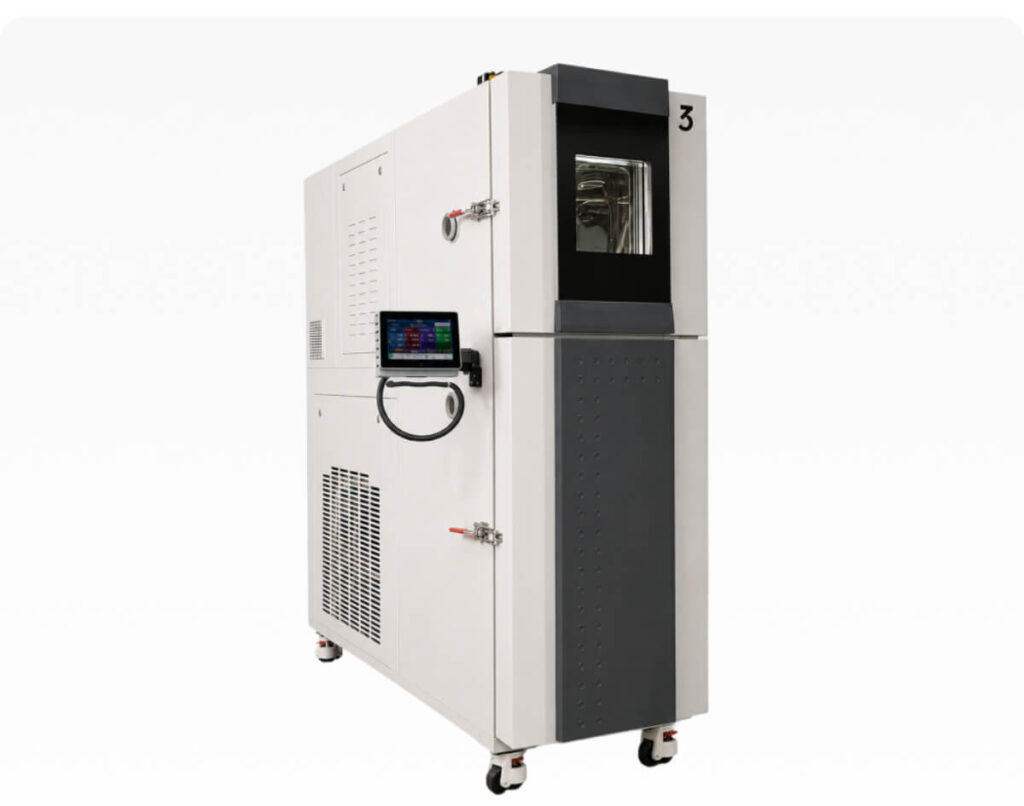
Thermal shock chambers move a product between extreme hot and cold in seconds, subjecting it to violent expansion and contraction that gradual cycling never delivers — revealing solder-joint fatigue, delamination, and differential-material failures before the field does.
T3 thermal shock chambers use independent preconditioned hot and cold zones with a moving basket that transfers the load in under 10 seconds and recovers zone temperature in under 5 minutes. Available in two-zone and three-zone, vertical and horizontal designs, they reproduce aggressive thermal transitions with the repeatability and throughput qualification programs demand.
These systems support electronics, automotive, aerospace, ceramics, glass, and defense programs where abrupt temperature change is central to design validation and reliability. Related: our thermal cycling chambers cover the gradual-ramp side of the same problem.
True thermal shock depends on how fast the DUT sees the delta and how quickly the zone recovers — transfer speed and recovery time are everything.
The moving basket transfers the load between hot and cold zones in under 10 seconds — the defining stress that separates shock from gradual cycling.
Zone temperature re-stabilizes in under 5 minutes, keeping throughput high across hundreds or thousands of shock cycles.
Independent hot and cold reservoirs held at temperature so the DUT experiences the full delta on transfer, per JEDEC and MIL-STD shock profiles.
Air-to-air two-zone and three-zone (hot / ambient / cold) designs, vertical or horizontal, sized from 2 ft³ up to fit lab constraints and DUT loads.
Send us your temperature extremes, transfer requirement, and DUT size. Our engineers respond with a matched chamber configuration within 24 hours.
Every chamber is configured around your temperature extremes, transfer requirement, DUT size, and lab footprint.
| Specification | Configuration |
|---|---|
| Standard Models | Standard / custom — 2 ft³ and up |
| Transition Time | Zone-to-zone transfer in under 10 seconds |
| Recovery Time | Zone re-stabilizes in under 5 minutes |
| Zone Extremes | −70°C to +200°C independent hot / cold reservoirs |
| Zone Designs | Two-zone and three-zone (hot / ambient / cold) air-to-air |
| Orientation | Vertical and horizontal designs to fit lab constraints |
| Controller Options | Watlow F4T / custom controls, touchscreen HMI |
| Data Acquisition (DAQ) | Integrated logging available |
| Remote Monitoring | Ethernet / remote access — Modbus / Ethernet |
| Lead Time | < 28 weeks |
Need gradual ramps instead of instant transfer? Compare ESS rapid-cycling chambers.
Thermal shock comes in a few flavors — the right one depends on how severe a transition your standard demands.
| Design | How It Works | Best Suited For |
|---|---|---|
| Two-Zone (Air-to-Air) | A basket shuttles the DUT between preconditioned hot and cold air zones in under 10 seconds | The vast majority of programs — electronics, components, and general JEDEC / MIL-STD shock qualification |
| Three-Zone (Hot / Ambient / Cold) | Adds an ambient dwell zone between the extremes for profiles that require a mid-point hold | Specifications that call for an ambient conditioning step or mixed shock-and-cycle profiles |
| Liquid-to-Liquid | Immersion shock in dual baths for the steepest possible thermal gradient | The most severe component-level shock — MIL-STD-883 device work where air can't transfer heat fast enough |
Shock vs. cycling: thermal shock transfers in seconds to precipitate expansion-mismatch failures fastest; thermal cycling ramps gradually (°C/min) to better represent in-service swings. Many programs use both.
Wherever materials of different expansion rates meet — solder and board, glass and frame, adhesive and substrate — thermal shock finds the weak bond first.
Rapid-change testing for boards and components — solder-joint fatigue and via cracking.
Thermal-stress validation for parts exposed to harsh under-hood and outdoor cycles.
Qualification of materials and assemblies exposed to flight temperature extremes.
Verifying strength and thermal-shock resistance of brittle materials.
Environmental durability testing under abrupt temperature swings per MIL-STD.
Evaluating seal and contact integrity under repeated thermal shock.
Assessing bond performance through repeated expansion and contraction.
Testing drift and failure under aggressive thermal transitions.
Studying enclosure and seal integrity across hot-to-cold exposure.
Identifying weak points before product release or certification.
T3 thermal shock chambers are configured to the temperature-shock and rapid-transition standards that govern electronics, defense, and component qualification.
| Standard | What It Tests |
|---|---|
| MIL-STD-810 Method 503 | Temperature shock — rapid transition between hot and cold extremes; see our MIL-STD-810 guide |
| JEDEC JESD22-A106 | Thermal shock for semiconductor devices |
| JEDEC JESD22-A104 | Temperature cycling for semiconductor devices |
| MIL-STD-883 Method 1011 | Thermal shock for microelectronics and components |
| IEC 60068-2-14 (Na) | Rapid change of temperature — thermal shock test method |
| IPC-9701 | Thermal cycling for surface-mount solder-joint reliability |
| RTCA DO-160 Section 5 | Temperature variation for airborne equipment |
Deeper reading: Top environmental testing standards you need to know.
Tell us the standard, temperature extremes, and transfer requirement — we'll configure the zones, basket, and profiles to run it exactly.
Every chamber is designed, manufactured, and serviced by our in-house Pennsylvania team — veteran-owned, US-built, and backed by lifetime engineering support.
We start with your temperature extremes, transfer requirement, DUT size, and standard — not a catalog number.
A matched configuration with zone design, basket, and recovery performance — within 24 hours.
Dual-zone shock construction fabricated by our Glenmoore, Pennsylvania team.
Transfer time, recovery, and zone stability verified against your profile before shipment.
Calibration, maintenance, and repair — for T3 chambers and every other major brand.
SDVOSB-certified and manufactured in Pennsylvania — a real advantage on defense and high-reliability qualification programs.
Sub-10-second transfer and fast zone recovery deliver the true thermal delta the standard calls for — repeatably, cycle after cycle.
24-hour response, NIST-traceable calibration, preventative maintenance contracts, and service on all makes and models.
A thermal shock chamber moves a product between extreme hot and cold conditions in seconds, subjecting it to violent expansion and contraction. It reveals solder-joint fatigue, delamination, and differential-material failures that slower cycling tests never expose.
Thermal shock transfers the DUT between preconditioned zones in seconds for a near-instant temperature delta. Thermal cycling ramps temperature gradually (in °C/min) within a single chamber. Shock precipitates expansion-mismatch failures fastest; cycling better represents gradual in-service swings.
T3 thermal shock chambers transfer the load between hot and cold zones in under 10 seconds, with zone temperature re-stabilizing in under 5 minutes for high throughput across long cycle counts.
Independent hot and cold reservoirs cover roughly −70°C to +200°C, so the DUT experiences the full delta the moment the basket transfers between zones.
Two-zone (air-to-air) chambers shuttle between hot and cold and handle the majority of programs. Three-zone chambers add an ambient dwell zone between the extremes for profiles that require a conditioning hold or mixed shock-and-cycle sequences.
Air-to-air covers most electronics and component qualification. Liquid-to-liquid immersion delivers the steepest possible gradient for the most severe component-level shock — typically MIL-STD-883 device work where air can't transfer heat fast enough.
Solder-joint and via cracking, delamination, seal and adhesive-bond failures, glass and ceramic fracture, connector-contact issues, and any weakness driven by mismatched thermal expansion between joined materials.
T3 thermal shock chambers start at about 2 ft³ workspace and scale up, in vertical and horizontal designs sized to fit lab constraints and DUT loads.
MIL-STD-810 Method 503, JEDEC JESD22-A106 and A104, MIL-STD-883 Method 1011, IEC 60068-2-14 (Na), IPC-9701, and RTCA DO-160 Section 5, among others.
Yes. T3 maintains, calibrates, and repairs thermal shock and dual-zone chambers from every major manufacturer — keeping transfer time and zone recovery verified for compliant results.
Tell us your temperature extremes, transfer requirement, DUT size, and the standard you're qualifying against. Our engineering team responds within 24 hours with a matched configuration and quote.
Veteran-owned · SDVOSB certified · Built in Glenmoore, PA · Lifetime engineering support