Quick answer
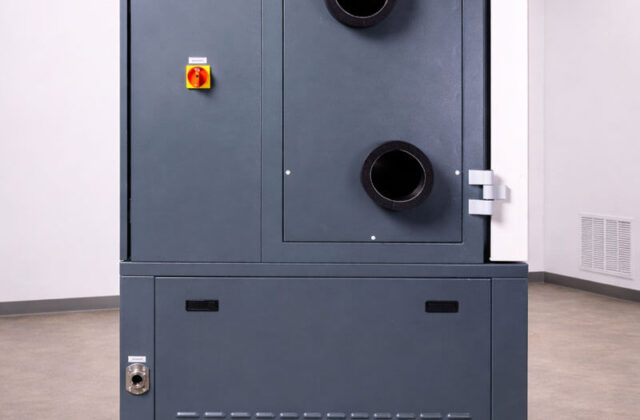
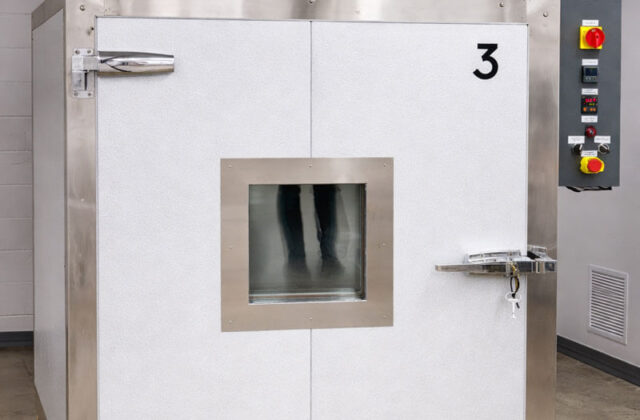
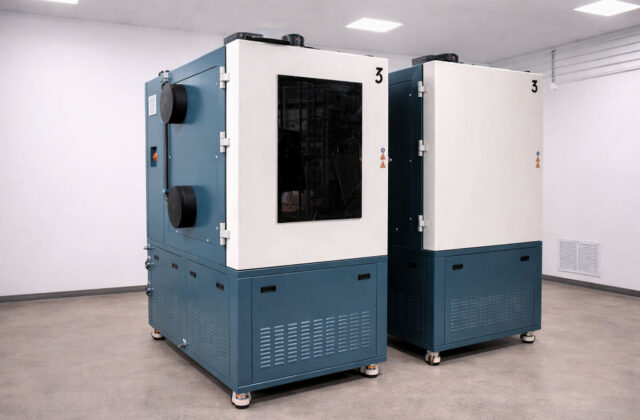
A drive-in test chamber is a large environmental chamber with vehicle-height doors and a reinforced floor, so a full vehicle or large assembly can be driven or rolled inside and held at controlled temperature and humidity. Drive-ins support cold-start, hot-soak, and EV thermal testing. T3 designs and manufactures custom drive-in chambers for full-vehicle work.
Key facts
- Drive-in chambers have wide, tall doors, a reinforced floor, and sometimes exhaust extraction and drive-through access.
- Drive-in refrigeration and heating are sized to the vehicle mass and any running-engine heat load.
- Typical drive-in applications include cars, trucks, buses, off-highway and military vehicles, and EVs.
- Drive-in chambers test to MIL-STD-810, SAE, and automotive OEM environmental specifications.
Some things you can’t put on a shelf to test — you drive them in. Drive-in test chambers condition whole vehicles and large assemblies at temperature and humidity. Here’s what they are, when you need one, and how they’re built.
A drive-in test chamber is a large environmental chamber with vehicle-height doors and a floor rated to roll or drive a full vehicle inside, then hold it at controlled temperature and humidity. T3 builds drive-in chambers for full-vehicle and large-assembly environmental testing.
What is a drive-in test chamber?
A drive-in test chamber is a walk-in-class environmental chamber engineered specifically to accept vehicles or very large equipment — wide, tall doors, a reinforced floor, and sometimes exhaust extraction and drive-through access. It conditions the whole item so cold-start, hot-soak, humidity, and thermal performance can be measured on the complete product, not just components.
When you need a drive-in chamber
- Full-vehicle testing — cars, trucks, buses, off-highway and military vehicles, EVs.
- Cold-start & hot-soak — verifying start-up, HVAC, and drivetrain across temperature extremes.
- Large assemblies — gensets, aerospace structures, industrial machinery that can’t be broken down.
- EV battery & thermal-management validation at vehicle scale.
How drive-in chambers are built
Drive-ins are custom: floor and door sized to the vehicle, refrigeration and heating sized to the mass and any running-engine heat load, temperature (and optional humidity) range to the standard, plus data logging, safety systems, and often exhaust handling for running vehicles. They test to MIL-STD-810, SAE, and automotive OEM specifications.
How T3 handles drive-in testing. T3 designs and manufactures custom drive-in test chambers for full-vehicle and large-assembly work, part of the full range of environmental test chambers — US-built with lifetime engineering support.
Frequently Asked Questions
What is a drive-in test chamber?
A large environmental chamber built to accept a full vehicle or large assembly and hold it at controlled temperature and humidity for testing.
What is the difference between a drive-in and a walk-in chamber?
Both are room-scale; a drive-in adds vehicle-rated doors and floor so a vehicle can be driven or rolled in, whereas a walk-in is entered on foot for large specimens and batches.
What is a drive-in chamber used for?
Full-vehicle cold-start and hot-soak testing, EV thermal validation, and environmental testing of large assemblies that can’t be reduced to components.
What standards do drive-in chambers run?
Typically MIL-STD-810, SAE, and automotive OEM environmental specifications, configured to the program.
Testing a full vehicle or large assembly? Request a quote and a T3 engineer will design a drive-in chamber for it.
Standards referenced