Quick answer
A temperature test chamber is an insulated enclosure with heating, refrigeration, air circulation, and controls that holds a setpoint and ramps between temperatures on a defined profile. Adding humidity generation makes it a climatic test chamber for damp-heat and humidity cycling. T3's reach-in temperature and humidity chambers cover the 150 to 1,500 L range.
Key facts
- T3's reach-in temperature and humidity chambers span roughly 150 to 1,500 L; larger loads move to a walk-in.
- A temperature-only chamber is simpler and lower-cost when a protocol never needs moisture.
- A climatic chamber adds an RH range for damp-heat, humidity cycling, condensation, corrosion pre-conditioning, and stability testing.
- Key selection factors are temperature range, humidity capability, workspace size, ramp rates, setpoint control, and test standards.
- Common standards include MIL-STD-810, the IEC 60068-2 series, ASTM, and ICH Q1A stability protocols.
The temperature-and-humidity chamber is the workhorse of environmental testing — the “climate chamber” most labs mean when they say they need a test chamber. Here’s what a temperature test chamber does, how to size one, and how to choose.
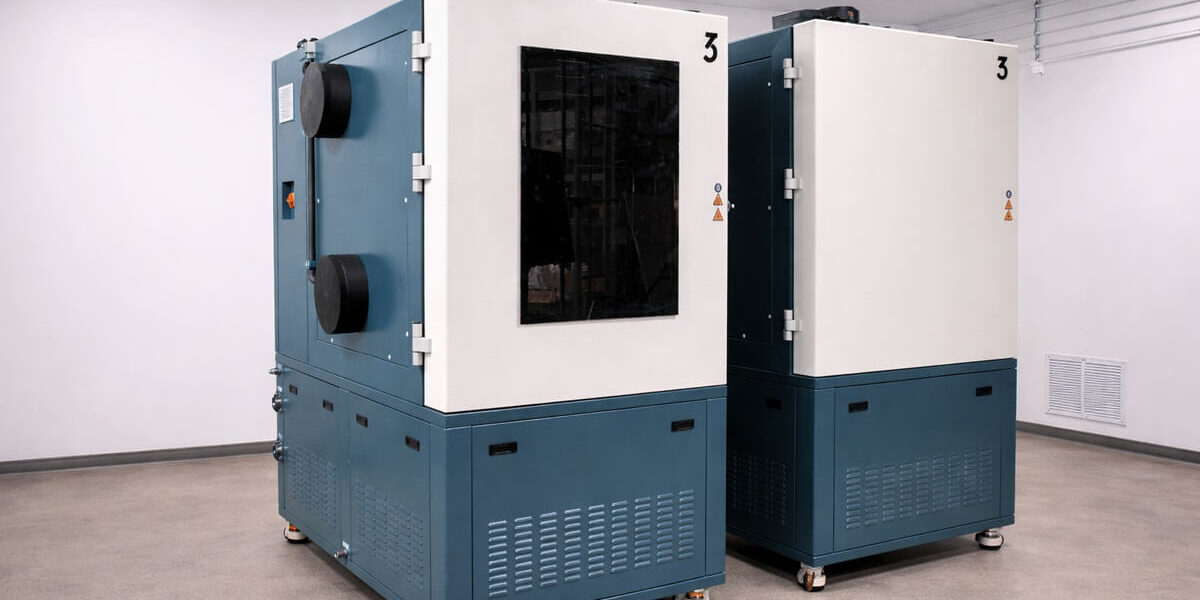
A temperature test chamber (also called a climatic or climate test chamber, or temperature/humidity chamber) controls temperature — and usually humidity — inside a sealed workspace so products can be conditioned, cycled, and qualified. T3’s reach-in temperature and humidity chambers cover the 150–1,500 L range that most component and assembly testing needs.
What is a temperature test chamber?
A temperature test chamber is an insulated enclosure with heating, refrigeration, air circulation, and controls that hold a setpoint precisely and ramp between temperatures on a defined profile. Add humidity generation and it becomes a full climatic (climate) test chamber, able to run damp-heat, humidity cycling, and condensation as well as temperature.
Temperature-only vs temperature & humidity
A temperature-only chamber is simpler and lower-cost when your protocol never needs moisture. A temperature-and-humidity (climatic) chamber adds an RH range — essential for damp-heat, corrosion pre-conditioning, and stability testing. If any current or future test involves humidity, specify it up front.
How to choose
- Temperature range — the extremes your product must survive, plus margin for accelerated testing.
- Humidity? — decide temperature-only vs full climatic now.
- Workspace size — to your specimens plus airflow clearance; reach-ins span 150–1,500 L (larger needs a walk-in).
- Ramp rates & control — how fast you must transition and how tightly you hold setpoint.
- Standards — MIL-STD-810, IEC 60068, ASTM, and ICH stability drive the spec.
How T3 handles it. T3 builds reach-in temperature and humidity test chambers configured to your range, size, and standards — the climatic workhorse in the full range of environmental test chambers, US-built with lifetime engineering support.
Frequently Asked Questions
What is a temperature test chamber?
An insulated chamber that controls temperature (and usually humidity) to condition, cycle, and qualify products. With humidity control it is a climatic or climate test chamber.
Is a climate chamber the same as a temperature chamber?
A climate (climatic) chamber controls both temperature and humidity; a temperature chamber controls temperature only. The terms overlap, but “climate/climatic” implies humidity capability.
What size temperature chamber do I need?
Size to your specimens plus airflow clearance. Reach-in chambers span roughly 150–1,500 L; larger loads move to a walk-in.
What standards do temperature/humidity chambers run?
MIL-STD-810, IEC 60068-2 series, ASTM, and ICH Q1A stability protocols are the most common.
Scoping a temperature or climatic chamber? Request a quote and a T3 engineer will size the right one for your tests.
Standards referenced